tin can essay
Mary Gant
3/1/18
Tin Can Essay
 In 1810 a turn of the century invention, the tin can,was created by a Frenchman named Philippe de Girard. This idea was passed along to a British merchant named Peter Durand who was used as an agent to patent the idea. Later, in 1812, Durand soldhis patent to two Englishmen, Bryan Donkin and John Hall. This invention was so revolutionary and changed the food and grocery industry and later in 1901, American Can Co. will be founded and make 90% of the tin cans in America. The tin can was a brilliant invention because made it so easy to store and keep food in good condition for longer periods of time.
The first tin cans were produced in 1813 for the Royal Navy and these cans were used for turpentine, seeds, and gunpowder. The two most common shapes were “soup tin” and “tuna tin”. The walls were stiffened with rib bulges, which was more common the larger the can was. These cans had a few different ways of being labelled for sizes and by what isin them. One way was a slip on label, which was good and bad, because if the label falls of there’s no way of knowing what’s inside. All together there were twenty one different sizes for tin cans. They varied from the 6.08 ounce can to the largest of the cans the 109.43 ounce can called No. 10. The tin-lead alloy seal and the ribbed edges were to prevent the can from being dented and split open so the product inside would remain safe.
 (slip on cover)
(slip on cover)
Because the early tin cans were sealed with tin-lead alloy, they could potentially give you lead poisoning. This was a big problem when they were first invented. There was a problem with dissolution of the tin into the food in the can even though tin is corrosion resistant, the acidic food in the can like fruits and vegetables can corrode the tin layer. This super unsafe problem lead to nausea, vomiting, and diarrhea as a result of food containing 200 mg/kg of tin. Another heath concern was Bisphenol-A, more commonly known as BPA. This toxic chemical compound is present in the plastic lining of tin cans and transferred into canned food. BPA causes organizational changes of the prostate, breast, testis, mammary glands, body size, brain structure and its chemistry, and behavior of lab animals, unborn children, and adults.
 (chemical BPA compound)
(chemical BPA compound)
This caused many problems for many years without people knowing that it was coming from the tin can linings. Chemists first synthesized BPA in a laboratory and was first documented in 1891. So that’s 78 years after the tin can being made and people getting sick until they realized what it was. But there was no mention of it until Thomas Zincke, from the University of Marburg, Germany, first mentioned it in the 1900s in a scientific paper. Nowadays, we try and make sure that we don’t ingest BPA because of its consequences. Later, a scandal not with the tin can but what was being packaged in the tin can, caused a big uproar with the public and the president.
 In 1898, The Spanish-American War soldiers were in desperate need of food. So a contract for meat was arranged by the Secretary of War, Russell A. Alger. They got their meat fromthe “big three” meatpacking companies. Morris &Co., Swift & Co., and Armour & Co. These were all located in Chicago. They arranged the meat inthe fastest way possible and at the lowest price possible. They took advantage of not having any rules or regulations for how meat was prepared and packaged and the extremely high demand for the meat. The companies cut corners when producing the meat therefore reducing the quality on the already heavily adulterated, meaning to make impure by the addition of a foreign substance.This was product that they were shipping for the United States contract to our own troops.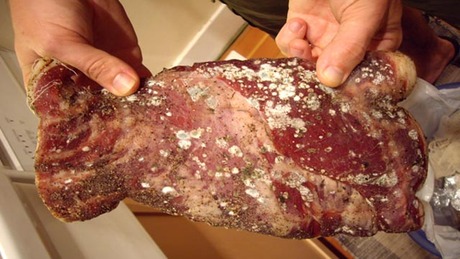
As a result of all these things, most of the meat that arrived in Cuba was so poorly preserved, chemically adulterated, and/or spoiled that it was extremely toxic and dangerous to eat. This meat caused an unrecorded number of sickness and deaths from contracting dysentery and food poisoning. The effects on the already sick with malaria and yellow fever were devastating. These diseases from the embalmed beef would eventually kill two times more men that the actual war itself. Because of the yellow fever symptoms being so close to those of bacterial food poisoning, which were fever, vomiting, severe and/or bloody diarrhea so there was little to no connection made between the Chicago beef and the illnesses.
 As a result of the scandal, by summertime in 1899, President William McKinley had decided that Alger had to be fired. Alger later resigned on August 1 by request of the president. Newspapers stirred up the public’s opinion on the topic which made everyone begin to criticize Alger on how he handled the army during the war. This phenomenon is now known as “Algerism”. Because of all the awareness that was raised by the beef scandal, a few different things happened as a result. In 1905, a man named Upton Sinclair wrote a book called “The Jungle” which raised awareness about the meatpacking business by describing the conditions of this industry. The F.M.I.A., or the Federal Meat Inspection Act was established in 1906. This act makes it illegal to adulterate or misbrand meat/meat products being sold as food and ensure that the animals are slaughtered in sanitary conditions.
The invention of the tin can for packaging food was a catastrophic discovery but it was also catastrophic in a bad way. There were flaws in the way they prepared, packaged, and sealed these cans containing our food. This effected the people that were fighting for our country and that's when it finally stirred up the public's opinion. One worried mother of a soldier said, "We are living under a generous government, with a good, kind man at its headwilling to give the Army the best possible, and yet thieving corporations will give the boys the worst." Even though there were many lives lost this got the tin can and the meatpacking industry to start making things better.
Hyper links:
Tin can
Hyper links:
Tin can
Comments
Post a Comment